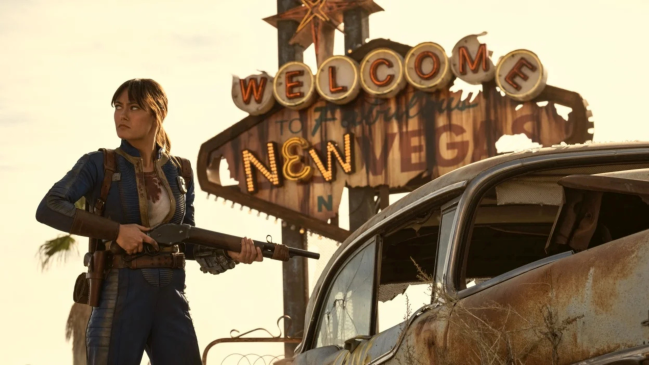

“Fallout” Season 2 debuts on Prime Video this Wednesday, December 17, and with it comes 2025’s final chance to live up to the long-promised “big moment for video game adaptations.” That’s a lot of pressure to put on series star Ella Purnell, but someone has to do something at a time when the Warner Bros. fire sale is throwing Hollywood into a tailspin — and collaboration with the roughly $188 billion games industry feels more urgent and essential than ever before.
Since Bob Hoskins and John Leguizamo donned overalls for 1993’s history-making “Super Mario Bros.,” audiences have been told to keep an eye out for the next great wave of storytelling. Progress has been slow, both technically and creatively. There have been notable successes (h/t “Pokémon: Detective Pikachu”), but the history of game-to-screen adaptations is still broadly defined by misfires, misunderstandings, and routine public embarrassment.


From financial wipeouts to baffling misreads of beloved source material, some of Hollywood’s most notorious flops began as video games. Those failures widened the cultural gap between audience types and reinforced the sense that the traditional entertainment industry was losing touch with younger consumers. In 2025, the film and TV business largely avoided those mistakes — delivering theatrical hits that made real money and prestige TV shows that won awards. And yet, the art form still feels stuck.
Several major video game projects, including “Street Fighter” and “Mortal Kombat II,” just quietly shifted their release dates into 2026, and while delays don’t always signal trouble, they rarely inspire confidence when it comes to adapting games. At best, the push postpones the cross-medium renaissance Hollywood has been predicting for more than 30 years. At worst, it raises the possibility that the breakthrough moment may never come.
So what did the industry really learn about video games in 2025? And what’s ahead in 2026?
Gamers Don’t Show Up for Movies, They Flock to “Events”
This year, “A Minecraft Movie” became a box office sensation, earning more than $957 million worldwide. With less than two weeks left to go in 2025, it’s the highest-grossing film in the U.S. and fourth on the global stage, where it trailed just behind Disney’s “Zootopia 2,” the live-action “Lilo & Stitch,” and the Chinese animated sequel “Ne Zha 2.” “Minecraft” director Jared Hess, first known for the indie darling “Napoleon Dynamite,” brought his signature style and a practical touch to the project, widely pleasing families and fans.

Still, critics broadly dismissed the release as a kid-friendly cash grab — an assumption that was no doubt fueled by the presence of A-listers Jason Momoa and Jack Black. “Minecraft” was the year’s definitive summer tentpole, and the sandbox epic also spurred a viral trend so massive it gave the release an annoying reputation in theaters. The “chicken jockey” controversy — which mostly involved children screaming and throwing popcorn — frustrated cinephiles, but it also made the movie more appealing to some ticket holders.
Blumhouse’s new animatronic slasher “Five Nights at Freddy’s 2” beat projections, too. After a solid opening weekend, the jumpscare-heavy haunting once again proved that brand loyalty matters more than reviews when it comes to getting gamers in theaters. Critics were predictably unmoved by the sequel, but fans showed up anyway. Like “Minecraft,” the appeal wasn’t just the movie itself, but the communal ritual around the IP. That’s reflected in the “Five Nights at Freddy’s 2” meme-filled merchandising and even its script, which is full of Easter egg moments.

Gamers didn’t reliably show up for movies in 2025, but they did underline their interest in events. Going forward, theatrical success for video game adaptations won’t hinge on persuading skeptics or expanding the genre’s language. (For all its gutsy experimentation, the “Until Dawn” movie didn’t do much at the box office.) Instead, it will depend on giving fandoms a time, a place, and the permission to share their communities with us.
Prestige TV Has Made Games Respectable, Not Revolutionary
If 2025’s theatrical releases demonstrated the power of video game adaptations as in-person events, prestige TV shows were meant to demonstrate their potential as art. This year, “The Last of Us” Season 2 and “Fallout” Season 2 both arrived as victory-lap projects — expensive, confident continuations of Emmy-winning series that critics and fans already legitimized.
For decades, small-screen video game adaptations have struggled to clear even the lowest bar of competence. That’s what made recent hits like “Arcane” and “The Witcher” such a big deal at Netflix, and why classic games like “Devil May Cry” just reached the small screen this year. Still, in 2025, prestige TV— increasingly hampered by a struggling business model that’s more interested in sure-fire sustainability than bold, creative risk — felt like the end, not the future, for video game adaptations.
HBO’s “The Last of Us” remains one of the most successful video game adaptations Hollywood has ever produced. Still, its second season leaned so far into the familiar grammar of prestige drama that showrunner Craig Mazin looked to be playing it safe. The story’s most challenging ideas remained on screen, and the season sparked intense discourse among gamers — some thoughtful, some predictably anti-LGBTQ and hostile — but the work itself rarely pushed beyond translation.

What once felt formally daring in the games became carefully managed dynamite on screen, failing to innovate even as subplots rapidly expanded and the show’s apocalyptic symbolism grew weightier. When Season 3 arrives, “The Last of Us” will also be without franchise creator Neil Druckmann and his games co-writer Halley Gross, whose exit from the series could jeopardize what does work.
Meanwhile, “Fallout” comes back to TV audiences this winter with its retro-futurist absurdity and episodic mysteries that transformed the games’ chaos into something slick, funny, and broadly accessible last year. But as IndieWire’s Ben Travers explained in his Season 2 review, the latest installments get bogged down by world-building and franchise positioning — effectively deferring emotional resolution and narrative momentum too long for a game or a TV show.
“‘Fallout’ Season 2 too often prioritizes planning over payoffs,” Travers wrote. “Showrunners Geneva Robertson-Dworet and Graham Wagner steadily unveil more territories, more clans, and more characters across their vast, open-world landscape, but to do so, they constantly pivot from one loosely connected plot to the next, stranding characters in slow-moving arcs destined to come crashing together sometime in the (fairly distant) future.”
That dynamic has become familiar across prestige video game adaptations, possibly because showrunners and filmmakers get overwhelmed by the richness of the source material they’re tackling. Ironically, forward motion can be slowed by focusing too much on what comes next, and in 2025, TV shows based on video games felt stale specifically because of that fact. In general, these types of series are confident enough to exist, but hesitant to commit; eager to build imaginative engines, but reluctant to ride them anywhere.

Hollywood Is Still Borrowing IP, Not Adapting a Medium
As Hollywood looks ahead to 2026, it’s worth asking what video game adaptations really “need” to accomplish in the modern landscape. Film and TV creatives largely continue to treat video games as brands to adapt, not storytelling systems to understand. And lifting familiar characters and worlds while ignoring the emotional mechanics and artistry that gave them meaning has generally been a mistake.
Ironically, the industry has had no trouble learning from video games when it comes to craft. Game-engine and performance-capture technology continue to reshape moviemaking at the highest level, from virtual production environments to animation/special effects pipelines. The “Avatar” franchise is still hard at work refining motion-capture techniques to better translate physical performance, and the success of James Cameron’s fantasy epic is a reminder of how game tools drive innovation in film.
What hasn’t followed is a similar evolution for the genre’s narrative form. Interactive entertainment is built around iteration, consequence, and learning through failure, and that’s tough to replicate at a time when TV and film crave stability. In a year defined by corporate retrenchment, adaptations weren’t treated as opportunities but lifeboats — and the spirit of play never fully reached screens big or small in the end.