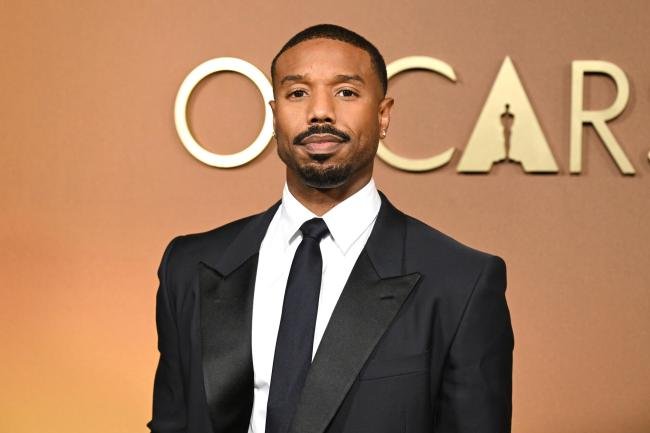

In the spirit of us both being fans of Japanese anime, specifically the shōnen genre that filled Cartoon Network and Adult Swim’s Toonami programming block, like “Dragon Ball Z” and “My Hero Academia,” I ask Critics Choice and Golden Globe Award nominee Michael B. Jordan what arc his career is currently in.
As we sit in a post-production suite inside of the private Los Angeles residence that’s getting ready to host a brunchtime screening of “Sinners,” the actor’s latest shared triumph with filmmaker Ryan Coogler, I can see the hours of series watched run through Jordan’s head, trying to place himself in one of the worlds of the shows that he’s said helped inspire the action scenes of his directorial debut, “Creed III.” “I’m evolving in real time,” he finally says. “I was going to say training arc, but it’s like preparing for the next evolution.”


Providing a reference for our fellow weebs out there, Jordan jokes that the closest comparison he could think of was being the center of “The Fourth Great Ninja War” arc in “Naruto” (which somehow feels like it could apply the current state of Hollywood.) He is almost dressed for the part too, of his favorite fictional shinobi, wearing a semicasual combat green set with brown leather tabi loafers.
Though getting the actor to talk about his love of anime has been the recipe for many a viral moment, in this specific case, discussing the shōnen genre does provide a good framework for walking through his career, and how he got to a place where he and Coogler could have an unconventional spring release for a well budgeted Southern Gothic period piece that manages to incorporate vampires with a dissertation on the history of Black music in America, and the film not only earn them the best reviews of their careers, but become the highest-grossing original live-action film since “Inception.”
In the simplest terms, shōnen anime tells coming of age stories targeted toward young men, often characterized by tons of action and adventure as the protagonist goes on a heroic journey of unwavering self-improvement. After viewers are given a sense of the world, and how it works, one of the signature tropes is for the character to go into the aforementioned training arc, where they first learn to harness their skillset. For Jordan, this was his time on television, starting with the ABC soap opera “All My Children.” “We were doing a hundred plus pages a day. One and a half episodes a day, just being prepared and being professional,” he said, “That was where I really learned a lot of that etiquette.”

While his still oft-discussed time as Wallace on the first season of “The Wire” on HBO had preceded that job, the momentum off his soap run would lead Jordan toward becoming one of the most prominent young TV actors of the late 2000s, early 2010s, by “going from one show to another, trying to make a splash, make an impact, making this moment, this episode work,” he said. “Just trying to make the most out of whatever little opportunity, whatever space I had.”
Prior to meeting Coogler, Jordan’s first significant ongoing creative collaboration was with showrunner Jason Katims, first with him leading one of the later seasons of creator Peter Berg’s “Friday Night Lights,” and then appearing in a significant recurring role on the Katims-created NBC series “Parenthood.” It would be those two figures who’d suggest he think about creating work for himself as a producer. “Peter Berg and Jason Katims told me, ‘You know, Mike, ownership. Start writing, start building things. You’re going to get tired of waiting for the phone to ring, and you’ve got to take control of your own destiny,” he said.
In hindsight, it seems like the actor had impeccable taste in roles, having appeared on shows that regularly make Best TV Series of the 21st Century lists, but that would be rewriting history. Jordan clarifies that he could not afford to be so calculated about starting out in either film or TV. “There were obviously the movies that I auditioned for that I didn’t get, the ensemble casts. The few leading Black male roles that were available at the time I wasn’t old enough (for), or didn’t read old enough to be in that ballpark, so TV was a space where there were more characters and more opportunities for me to work,” he said. “There’s this misconception when you’re at that phase, at that age, at that time and era, that you have a lot of choices. You book something, it’s more likely you’re doing it.”
He jokes “It wasn’t like, ‘Oh, yeah. No, I didn’t want that one.’ ‘Oh, I’m not ready for this role. What? Preposterous.’ ‘No, no, no. Come back to me when you have something better.’ In my early 20s and in my late teens, that was just working on what was available.” His film work did happen to coincide with the dawn of the streaming age, where “that stigma behind movie stars go to TV to die. And TV actors don’t translate to film . . . that stereotype, whatever that was, I missed that one,” he said. But “there were the movies that I always wanted to do, but I didn’t really see a lot of roles that were available to me. That was the older generation. Those movies like ‘Independence Day,’ and ‘Men in Black,’ and the plethora of Denzel films, and Samuel Jackson, et cetera, et cetera.”

Following Berg and Katims’ advice, “once a week, if I could afford it, (I would) go dumpster dive for books and IP and things that just felt like there was a story, and read things that can help my imagination,” said the actor. “Being ready for any meeting or any conversation or somebody going on or a pitch or an idea or whatever. I just always wanted to be ready for something around that era.”
A decade as a child actor, trying to be observant as possible in order to understand the nuances of the entertainment business taught Jordan that “if I do well, build good relationships, work hard, it may turn into an opportunity down the road that I don’t see,” he said. Enter Coogler, who’s first words upon meeting Jordan to discuss him starring in his feature directorial debut “Fruitvale Station” were “Yo, I wrote this for you.” “You wrote this for me?,” said Jordan, mimicking the conversation where the director first told him he believed he was a movie star. “Ok. You believe in me? Oh, shit. You think I’m this? I think I’m that too. Nobody’s ever told me that. All right, let’s go do it.”
The actor said he could tell Coogler was legit. “There’s a connection there, there’s a feeling, there’s an instinctual intuition that’s like, ‘Ok, there’s something real here,’ and that vibe instantly,” Jordan said. “Before we even shot ‘Fruitvale Station,’ he pitched me ‘Creed,’ and I said yes to that. So I already had two films with Ryan before I’d even shot one frame.”
Going back to the shōnen metaphor, the back-to-back roles as the hero of the Oscar-nominated “Rocky” spin-off and the villain in “Black Panther,” the first ever superhero film nominated for Best Picture, represented Jordan’s tournament arc. This is the point in the story where the anime protagonist becomes battle-tested, proving themselves on a world stage.
Allow Jordan to explain the common arc that leads to a movie star’s breakout moment: “If you get one huge film, and then you do something really small, that pairing works really well for talent. And that year that gives you the boost to be a bit of everywhere throughout town. And you maximize that opportunity, that window. You’re like, ‘All right. From this (time) window, I’m going to be on a press tour for this.’ Blasé blah. And then, if it’s a big commercial film, sometimes maybe the quality of that may not be the prestige of that movie, but it gives you all these other commercial successes, puts you in places, puts you in middle America, et cetera, et cetera. Then, you go do this smaller joint that is for the prestige. It’s for more of the craft. That gives you the respect, gives you more of a range of what you can do as an actor, et cetera, et cetera. But it’s not broad. It’s for the people that know. The tastemakers that’s going to move you along.”

However, for him and Coogler, lightning struck twice. Both “Creed” and “Black Panther” represented both paths. The first “Creed” “felt like a commercial film with an independent heart,” said Jordan, while “Black Panther” was an even bigger blockbuster that was still very heartfelt and dynamic. His character Killmonger, in particular, “felt layered and complicated,” he said. “So yeah, that was the tournament arc that really put me on the map and solidified things in a big way.”
From that point forward, Jordan would take on an even bigger role behind the scenes through his production company Outlier Society, leading him to produce and star in films like “Just Mercy,” “Without Remorse,” “A Journal for Jordan,” and the “Creed” sequels. He would still have a cameo appearance in Coogler’s “Black Panther: Wakanda Forever,” but would focus more of his attention toward helming “Creed III,” which met the critical standard of his films with Coogler, and became the highest-grossing “Creed” film and the second highest-grossing “Rocky” film after grossing over $276 million worldwide.
Having proved himself as a filmmaker in his own right, “Sinners” provided Jordan a way to start anew, taking on his biggest challenge yet in playing identical twins. “These are full-blown gangsters. They went to war. They’ve taken life from people. These are fully formed men,” he said of his Smokestack Twins. “A lot of my earlier characters, they’re going through these boy-to-man phases. These brothers are who they are from start to finish.” It pains me to not include the caveat he provides for one of them, but that’s a spoiler.
While he did find personal connections to the film, “Sinners” more so required him to focus on the one creative task at hand, and be of service to Coogler’s vision. “As an actor with Ryan specifically, and most directors, you become a vessel for their message, for what they’re trying to say. And what’s personal to Ryan is personal to me. You want to deliver it in a big way,” he said of working with his longtime collaborator on the Warner Bros. Pictures release that has become one of the awards season frontrunners.
Jordan developed a more advanced version of his preparation process, writing journals with backstories for his characters—a technique he began employing after starring in the 2012 WWII film “Red Tails.” Having a journal for both the reserved Smoke and energetic Stack, he particularly enjoyed the exercise of thinking how two different perspectives could come from such a shared experience. “I know they have a tally of how many times who’s been right and wrong between the two of them. So that running joke of, ‘I’m right this time.’ ‘No, you’re right this time.’ ‘No, you’re wrong this time.’ It’s something that I subtextually had between the two of them that always kept them trying to one up each other a little bit, which was fun,” he said.

Though every film they have made together in the past decade in a half — between “Fruitvale Station” and “Sinners” — has been nominated for at least one Oscar, Jordan has never been nominated for Best Actor, and Coogler has never been nominated for Best Director. Both have said in the past that they prefer for the work to speak for itself, but outside looking in, it has often felt like they were ahead of their time in what the Academy chose to celebrate. When asked if it feels like that particular prestige audience has finally caught on to the pair’s excellence for, of all things, a vampire picture, Jordan agrees.
“We’ve become something people can count on. I think we’ve delivered consistently. Haven’t missed. And that is something now you can’t deny,” said the actor. “We came out super early, so the fact that we’re still in conversation, having these conversations come December, is a testament to that. Letting the work speak for itself.”
Having seen the filmmaking pair speak at several recent celebrations related to “Sinners,” I can confirm that Jordan and Coogler have entered this awards season exuding a lot more confidence. “We’ve been from independent film, to franchises, to blockbusters, to an original IP blockbuster. There is a bit of solid foundation and milestones that we’ve hit pretty early. (We’re) lucky to have that earlier on,” said the actor, when asked what has contributed to what he describes as their recent “looseness.” He adds, “We’re both in our late 30s. We’ve been in this industry for a long time. Me, a bit longer than him. And this is the highest peak that we’ve been at so far. So yeah, this is the best version, this is the most recent update of ourselves that we have to show.”
His conclusion conveniently fits the current shōnen arc he’s put upon himself. “I’m in that phase of evolution, and continuing to put my foot on the gas. I’m ready to keep rocking,” said Jordan, who is enjoying his last stretch of “Sinners” promotion, before going back to post-production on his next acting and directing effort, a remake of “The Thomas Crown Affair” scheduled for March 2027.
For more analysis of “Sinners,” and the 2026 Oscars race as a whole, read “IndieWire’s The Lead Up” where our Awards Editor Marcus Jones takes readers on the awards trail, interviewing more key figures responsible for some of the most compelling stories of the season, and offering predictions on who will win. Subscribe here to receive the newsletter in your inbox every Tuesday.